
Overview
According to the 2017 American Community Survey, 34% of US residents live in a rented space with numbers increasing each year. Although this is great news for landlords/property managers/complexes, there is still tremendous issues with communication amongst tenants and landlords. This has proven to be strenuous not only for tenant and landlord relationships, but also in legal battles.
We designed a mobile application, Rental, to create a comprehensive property management application that focuses on strengthening the communication between landlords and tenants. With our app, both parties will be held liable to respond within 48 hours or they would be charged a small inconvenience fee until the issue is marked resolved. Other abilities of our app will include direct rent payments, maintenance requests, profile scoring systems, direct message capabilities, a calendar system, and consolidated storage for lease agreements and paperwork.
Duration
4 months (September 2019 - December 2019)
Team
Edie Terrell / Lydiah Bazan / Courtney Stark
My Role
-
Performed research on Tenant and Landlord relations via surveying.
-
Created sketches, mind maps, wireframes, and various levels of fidelity, brand collateral, and conducted usability tests to iterate ideas.
-
Participated in visual design and High Fidelity prototype creation.
-
Participated in wire framing and user testing the application on IOS hand held device.
Tools
Challenge
Create an application that will aid locals in College Station.
Adobe XD / Adobe Illustrator / Adobe InDesign / Adobe AfterEffects
Product Preview
According to the 2017 American Community Survey, 34% of US residents live in a rented space with numbers increasing each year. Although this is great news for landlords/ property managers/ complexes, there is still tremendous issues with communication amongst tenants and landlords. This has proven to be strenuous not only for tenant and landlord relationships, but also in legal battles.


research & Empathize
Competitive Analysis
For further product ideas and to evaluate existing products and services in the market, we did a competitive analysis of other similar products that help landlords manage their properties. Our application would be competing in a red ocean market; however, current applications only focus on landlord use or just one aspect of property management. Rental plans to strengthen landlord and tenant relationships by ensuring the application involves both parties in one consolidated app.
Competitors & Market
Although there are property management applications that already exist, we found that a majority of free applications were exclusively focused on landlords and had dated designs that were covered by multiple ads. Other more established applications required payment upfront and focused on apartment complexes, leaving a gap for landlords that only manage 1-5 properties. Possible competitors included: Appfolio, Rental Property Manager, Rentsum, and Apartment Assistant.
Apartment Assistant


-
Untrustworthy UI
-
Limited capabilities, only allows for the action of paying rent
-
No payment history, receipts
-
No confirmation of payment going through
Rentsum
-
UI needs updating
-
Hard to differentiate different tenants other than differing addresses
-
Program doesn't include pro-rated rent
-
Security Deposit needs to be displayed as returnable income, not rent


User Research
To validate our idea, we conducted preliminary research including literature review and a questioner sent to local tenants and landlords in the Bryan/ College Station area. This helps generate personas and extract pain points to find opportunities to work on.
Initial Ideas
In order to get an effective approach to correct the flaws in communication between tenants and landlords, our research included familiarizing ourselves with Texas Laws associated with rental properties and leases. During literature review phase, we developed a broad understanding of how local individual landlords operated their businesses', their challenges, and generated potential ideas based on what other platforms in the market were lacking and what landlords and tenants found most valuable when entering into a lease agreement.
Questionnaire
To get accurate information and opinion on our approach, we were able to survey 45 tenants and 4 landlords. Our demographic mostly consisted of Texas A&M University students and Bryan/ College Station residents.


We collected contextual user research on the local tenant/ landlord population in College Station through surveys. This helped us gain a better understanding for our end user's needs and pain points and in generating a more accurate persona.
View the Survey: https://rb.gy/09mjcx

/ User Research Questioners
Research Data Synthesis
Once we had collected all the data through research, we externalized it on a whiteboard to get a holistic picture, and make meaningful analysis. This process of viewing all information at one glance helped us connect research and derive research-based product direction. Although we initially envisioned this app to be used for apartment complexes as well as individual property owners, we quickly pivoted our market focus. Our results concluded that a majority of tenants that live in apartment complexes have their own property management portal; therefore, the greater need was for individual property owners.

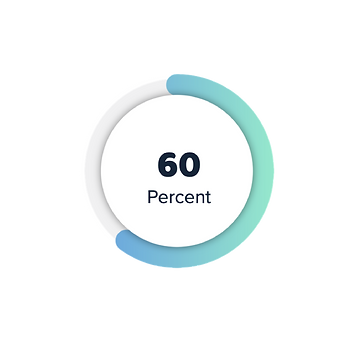


80% of participants expressed interest in our app proposal.
60% of participants are NOT aware of tenant rights.
51% of participants have communication issues with their landlord.
55% of participants have issues with delays in requested repairs.


Initial Research Findings
After we completed our research, we explored the pain points and opportunities uncovered to delve deeper into what our project direction and solution would be.
Pain Points
After analyzing our user research we were able to determine pain points and gain further insights into our user's needs.

Insights Gained


User Journey Map

Ideation
User Personas
Based on the information that we gathered from interviews, we created three personas for two types of tenants in differing demographics and landlords.

Design and Ideation
How might we emphasize with the users and aid in cultivating a better relationship between tenants and landlords?
We decided on the design principles and explored and ideated ideas to find the optimal solution to the problem.

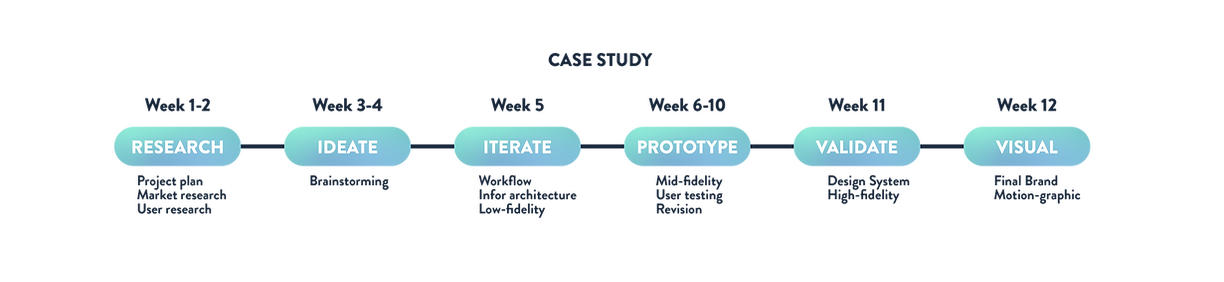
DESIGN & ITERATION
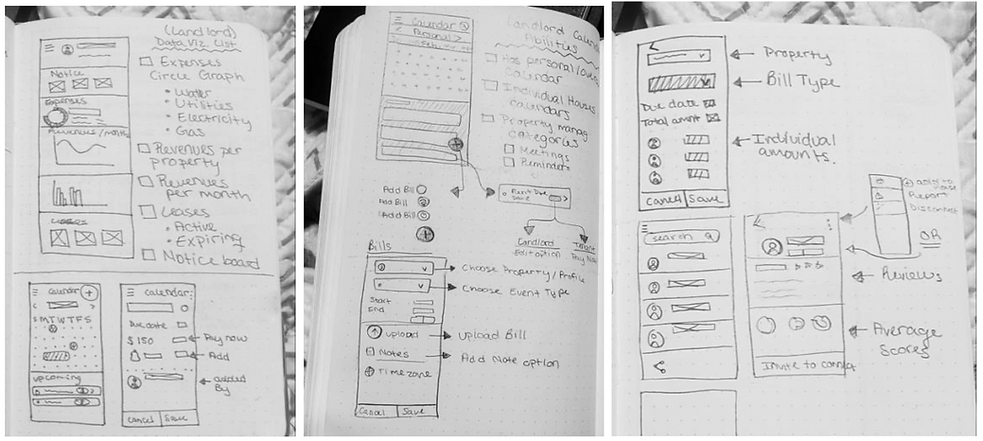
Our initial phases began with brainstorming with lists, mind-maps, and sketches. As a team, we aimed to target the most requested needs from our survey such as work order requests, communication, in-app payment, and a landlord/tenant reviewing system. We believed that both parties for renting are to be held accountable for living spaces and overall, should be a stress-free experience.
Interactive Design Flow
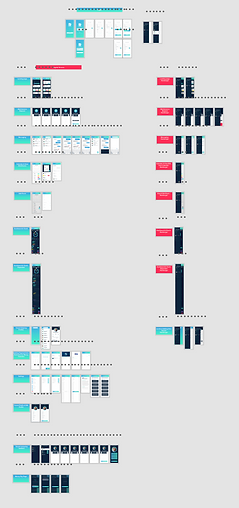
Alongside our sketching, we began developing user flows that involved decision trees to help better understand the journey of our users. This aided in the development of the app design as well as finding errors in our proposed designs.


First Round Low Fidelity Iterations 1.0
As we explored features, there appeared to be three major different features to push in this application. These features included timers and money incentive within messaging, KPI bills displays, Work orders, Calendar view of due dates and easy rent pay and transfer. To further validate which one would be a better choice for users, we created wireframes to test with users for feedback.


Digitized Iteration 2.0 and Testing
What do users think?
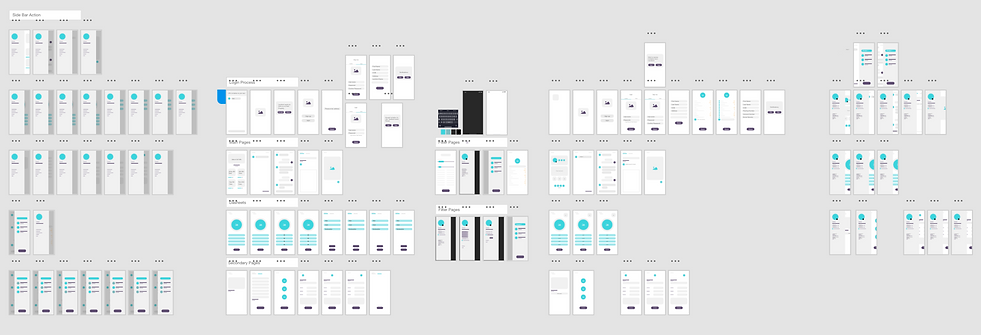

What should change?


High-Fidelity Designs 3.0
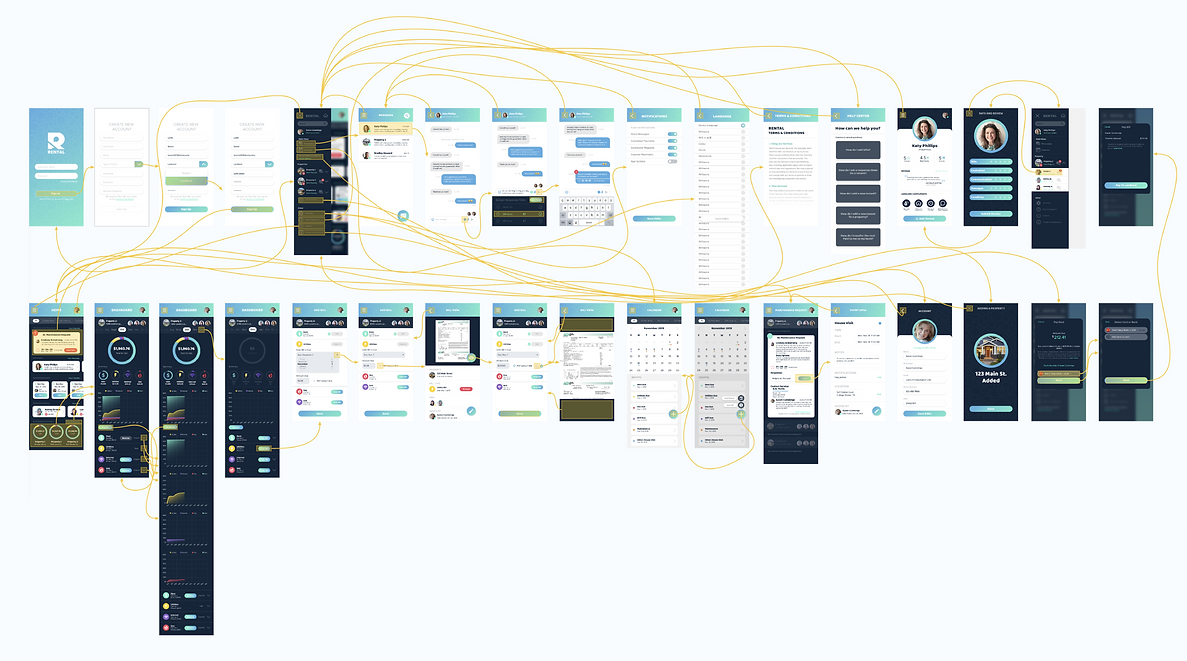
Final iterations included tenant and landlord facing interfaces.
After testing low-fidelity iterations, consulting our professor, and classmates on usability our high-fidelity designs were produced, by myself and Lydiah Bazan.
Tenant Facing Interactive UI
landlord Facing Interactive UI
What improvements did we make in our final iterations?


Brand & style guide
Book Link: https://rb.gy/wtm9zw

Motion Graphic
Created by Courtney Stark
Reflection
-
The User guides the design
When trying to understand the user we gain an understanding for that persons' pain points and what opportunities we can translate into our designs to improve the day in a life of that person, solve their pain points. Without proper user research and understanding for the end user, the designer and engineers assumptions can cloud design decisions and can turn into designing for oneself instead of the persona created from research.
-
Usability Testing
Time limitations and scope on this project provided for lacking within user testing. Optimally designs should be made and iterated based on user testing. With more time I would have liked to have conducted more user testing within mid-fidelity designs and then again within more high fidelity and make all the changes based on usability no look and feel.
